

Hiring Guide
What to Ask a PolicyCenter Developer in the First Ten Minutes
Six questions that separate configuration experience from exposure, with the answers worth listening for — and the follow-ups that catch a rehearsed reply.
Read moreThree questions that do the work. You do not need to know the regulation to tell whether a candidate has built the system that satisfies it.

You are a technology hiring manager and the open role is KYC — onboarding orchestration, customer risk rating, entity resolution, or a remediation programme. You can assess engineering ability comfortably. What you cannot assess is whether the candidate understands the compliance context well enough to make good decisions in it, and compliance colleagues are not always available for every first-round screen.
The good news is that you do not need regulatory knowledge to do this well. You need to ask about decisions rather than rules, because the quality of someone's reasoning is legible even when the subject matter is not.
KYC technology is a continuous negotiation between three pressures: the compliance file has to be defensible, the operations team has to absorb whatever the system cannot decide, and the customer walks away if onboarding takes too long. Every design choice moves at least two of those.
Anyone who has genuinely built or run one of these systems talks in those terms without being prompted. Anyone who has only advised on a target state talks about principles and frameworks. That difference is audible to a technologist with no compliance background at all.
You are not testing whether they know the regulation. You are testing whether they have made expensive decisions and can explain the reasoning.
The best single question on this brief. It asks for a judgement rather than a fact, and the second half is where the signal is.
Strong candidates have clear examples of things they chose not to automate — an edge case where the data was too unreliable, an ownership structure too unusual to codify, a decision the business wanted a person to make. They can explain who agreed that and why. Weak candidates treat every manual step as a failure they had not got round to fixing yet.
A number, and one the candidate should either know or be able to describe the movement of. It does not matter that you have no benchmark to compare it against — you are testing whether they measured the thing their work existed to change.
Follow up with the other half: and what did that do to the operations queue? Someone who improved automation while quietly pushing more cases into manual review has not improved anything, and the ones who understand that say so themselves.
Modern KYC leans on identity, document and data providers, all of which fail differently and some of which fail silently. Fallback design is where onboarding either degrades gracefully or stops.
You are listening for whether they had a plan: queue and retry, fall back to manual, accept a lower-confidence check with a flag for later review. Candidates who have never thought about it will answer as though vendors do not fail.
For corporate onboarding: “How did you handle a customer who appeared three times in different systems?” Entity resolution and duplicate handling quietly break risk rating, screening and reporting all at once, and corporate onboarding lives or dies on it.
For anything touching review cycles: “After you changed the trigger logic, how did you show coverage had not dropped?” The question tests whether they think about evidence, which is the habit that matters most in this domain.
Both are legitimate profiles and you usually need one specifically. The tells are consistent.
| Signal | Build background | Policy background |
|---|---|---|
| Detail level | Names systems, vendors, fields | Names frameworks and principles |
| Numbers | Volunteers rates and volumes | Describes outcomes qualitatively |
| Failure stories | Has several, specific | Has few, general |
| Operations view | Knows the queue and the SLA | Refers to “the business” |
| Trade-offs | Explains what was given up | Explains what was required |
Neither column is wrong. But if you are hiring someone to deliver an orchestration rebuild and every answer sits in the right-hand column, that is worth knowing before the technical panel.
You can run first-round screening alone. Bring a compliance colleague into the second round when the role owns risk rating design, review trigger logic, or anything that will be presented to audit — those are the areas where a plausible-sounding answer can still be wrong in ways only a practitioner will catch.
For orchestration, integration, entity resolution and data work, a technologist asking the questions above will get you a long way on their own.
Six questions that separate configuration experience from exposure, with the answers worth listening for — and the follow-ups that catch a rehearsed reply.
Read more
The gap is rarely the platform itself.
Read more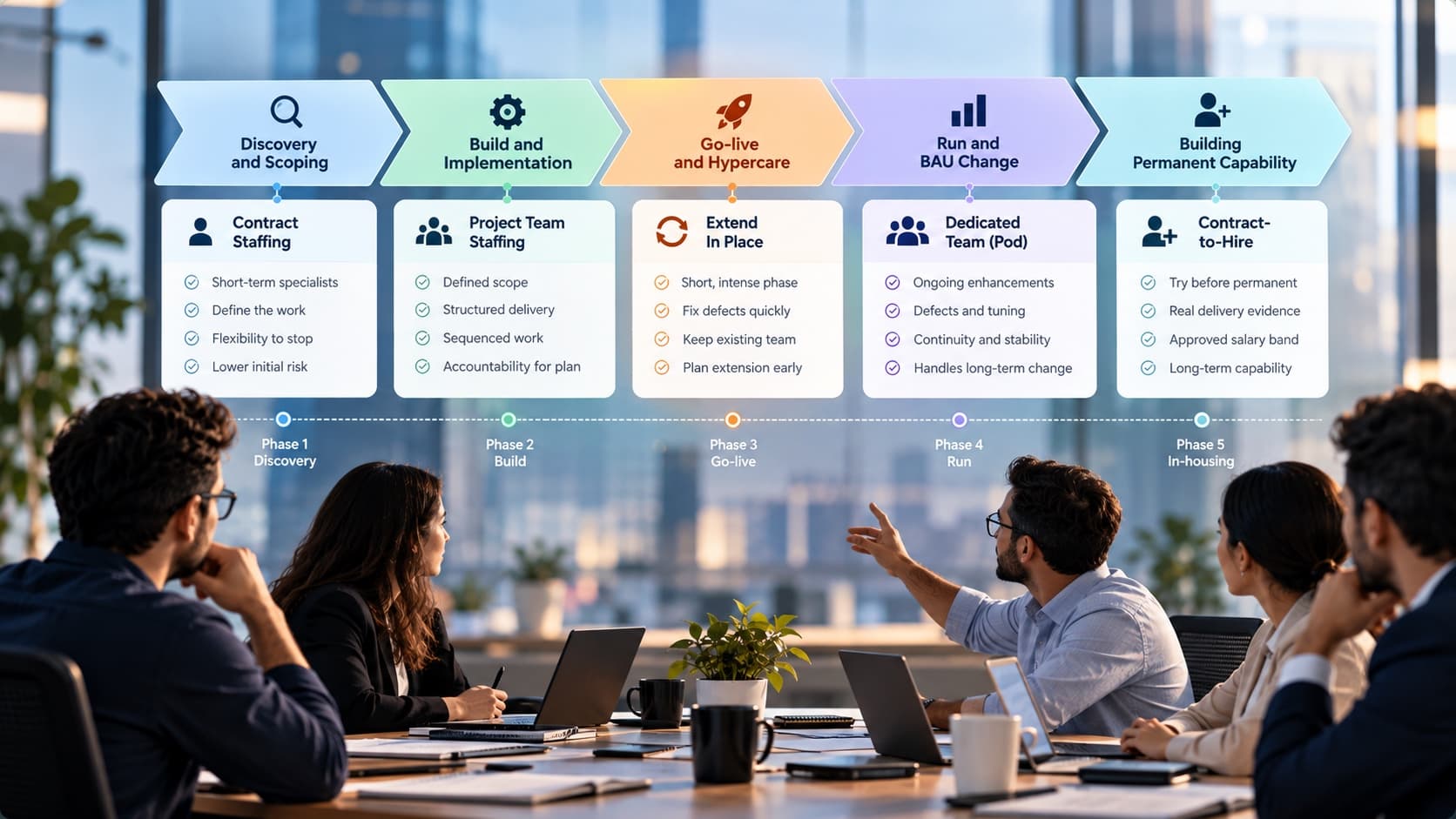
Match the model to the work in front of you.
Read moreSend a JD or a two-line outline. We come back with the roles that fit, an honest read on the market for them, and a shortlist against your requirement.
Hiring guides and market notes for insurance and financial crime technology teams.