

Hiring Guide
What to Ask a PolicyCenter Developer in the First Ten Minutes
Six questions that separate configuration experience from exposure, with the answers worth listening for — and the follow-ups that catch a rehearsed reply.
Read moreMatch the model to the work in front of you. Most staffing decisions go wrong because they are made on cost per head rather than on what phase the programme is actually in.
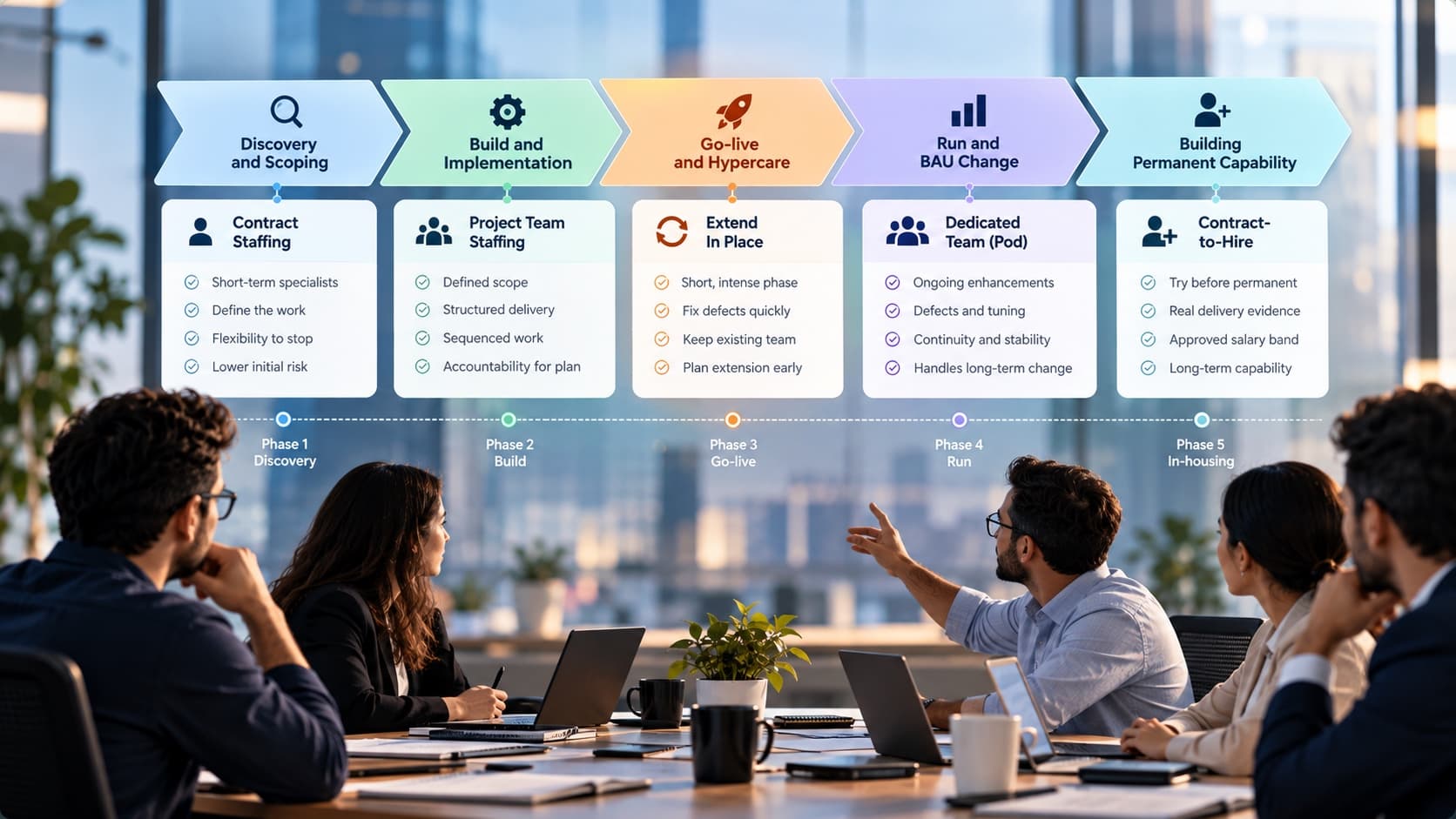
Almost every conversation about staffing models opens on cost. Which is cheaper, contractors or a managed team? What does a pod cost against four individual engagements?
It is the wrong first question, because the models are not really substitutes. They distribute different things — management overhead, continuity, delivery risk, knowledge retention — and the distribution that suits a discovery phase is close to the opposite of the one that suits a live platform. Choosing on rate and then discovering the mismatch is how organisations end up paying for a pod that idles or a project team that cannot plan.
A more useful question: what phase is this work in, and who should be carrying which risk?
You do not yet know what you are building. What you need is one or two experienced people who can tell you what the work involves, and you need to be able to stop cheaply.
Use contract staffing. A single senior specialist for a short period. Resist forming a team around a scope that does not exist yet — that decision is much cheaper to make in six weeks.
Scope is defined, there is a date, and the work needs sequencing across several people. This is the phase where somebody has to own a plan rather than a set of tickets.
Use project team staffing — but only if the scope will genuinely hold. If requirements are still moving weekly, stay on contract staffing until they settle. A led team with nothing firm to lead is the most expensive shape available.
A short, intense phase with an unpredictable shape. Defects arrive faster than features and the people who understand the build are the only ones who can fix them quickly.
Extend what you already have rather than changing model mid-flight. Plan the extension before go-live, not during it — the market for those specific people is you and nobody else, and they will have taken other work if you leave it late.
The platform is live and generating continuous change: enhancements, defects, rate cycles, tuning rounds, upgrade waves. Individually finite, collectively endless.
Use a dedicated team. This is the phase the model exists for. What you are buying is continuity — when someone leaves, replacing them and rebuilding their context is not your problem, and handover happens inside the team. If you have refilled the same contract seats three cycles running, you are already paying for a pod without getting one.
You have decided to own the platform internally and the first hires will shape years of configuration decisions.
Use contract-to-hire, with the salary band approved before the search opens. Two interviews are a poor way to judge a permanent hire onto a bespoke estate; three months of delivery is a good one.
| Phase | Model | What you are buying |
|---|---|---|
| Discovery | Contract | Optionality — the ability to stop cheaply |
| Build | Project team | A plan, and someone accountable for sequencing |
| Go-live | Extend in place | Context, at the moment it is worth most |
| Run | Dedicated team | Continuity when people leave |
| In-housing | Contract-to-hire | Evidence before a permanent commitment |
Forming a pod too early. A dedicated team needs a real backlog and someone on your side to prioritise it. Without both, it invents its own priorities and gets cut two quarters later, having damaged the case for doing it properly.
A project team against fluid scope. Everyone can feel this by week six. The lead cannot plan, the team waits on decisions, and the reporting measures activity rather than progress.
Contract-to-hire as a hedge. If the permanent seat is not approved, the candidate discovers it eventually and leaves — usually taking the programme knowledge with them. Straight contract staffing is the honest option.
Four questions, and none of them is about day rate. Cost is a real constraint, but it belongs in the conversation after the shape is right — not instead of it.
Six questions that separate configuration experience from exposure, with the answers worth listening for — and the follow-ups that catch a rehearsed reply.
Read more
The gap is rarely the platform itself.
Read more
And what to accept as a near match.
Read moreSend a JD or a two-line outline. We come back with the roles that fit, an honest read on the market for them, and a shortlist against your requirement.
Hiring guides and market notes for insurance and financial crime technology teams.